
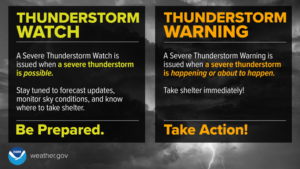
A severe weather threat continues to evolve in the northeast today, with threats of large hail, damaging winds, and isolated tornadoes. The National Weather Service says severe weather is starting a bit later than initially expected, with Severe Thunderstorm Watches being posted now for portions of the Northeast now. While the core of severe weather was initially expected to strike between 3pm and 8pm, the National Weather Service now says the peak will be a bit later between 5pm and 12 midnight.
In general, scattered severe thunderstorms capable of damaging wind gusts and some hail are expected this afternoon and evening from the Upper Ohio River Valley into the Northeast, and from the Appalachians into the Mid-Atlantic States. This morning, an area of low pressure was near southeastern Lower Michigan and had an extensive cold front which arcs from northwestern Ontario south-southwestward into southern Illinois and then more southwestward through southern Missouri and central Oklahoma into the Texas Permian Basin. This cold front and attendant low are forecast to progress eastward today, moving just ahead of a shortwave trough pivoting within the base of a larger upper trough from the Ohio Valley through the Northeast.
Daytime heating today has contributed to airmass destabilization ahead of the cold front, with temperatures in the 80s and dewpoints in the mid 60s resulting in moderate buoyancy across the Middle to Upper Ohio Valley. The National Weather Service’s Storm Prediction Center (SPPC) says that modest height falls and ascent along the front will support thunderstorms within this moderately buoyant environment.

“Around 40 kt effective shear could support a few initial/semi-discrete supercells prior to more prevalent upscale-growing linear modes, with the primary concern being damaging wind gusts, particularly in the Ohio/Pennsylvania border vicinity where the best overlap of better buoyancy and shear exists. A brief tornado and/or hail could also occur given the relative strength of the wind profiles,” warns the SPC in their latest Convective Outlook.
The SPC says that cooler temperatures and lower dewpoints will lead to more limited buoyancy farther northeast, such as the area from western New York into New England. However, even there, the SPC expects the the airmass to destabilize, supporting afternoon and evening thunderstorms along and ahead of the front.
Thunderstorm development is also anticipated along the modest lee troughing expected to extend across the region this afternoon and evening. This development is forecast to occur well ahead of the cold front mentioned in the previous subsection, resulting in a
separate area of strong to severe thunderstorm potential from the Carolinas into the Mid-Atlantic.
Heating of this airmass will result in moderate to strong surface-based buoyancy. The SPC says that shear will be weaker than areas farther north but still sufficient for organized clusters and/or perhaps a few supercells. The SPC adds that the primary risk will be damaging gusts, with this potential maximized from eastern Pennsylvania and New Jersey southward through the Virginia Tidewater region.
