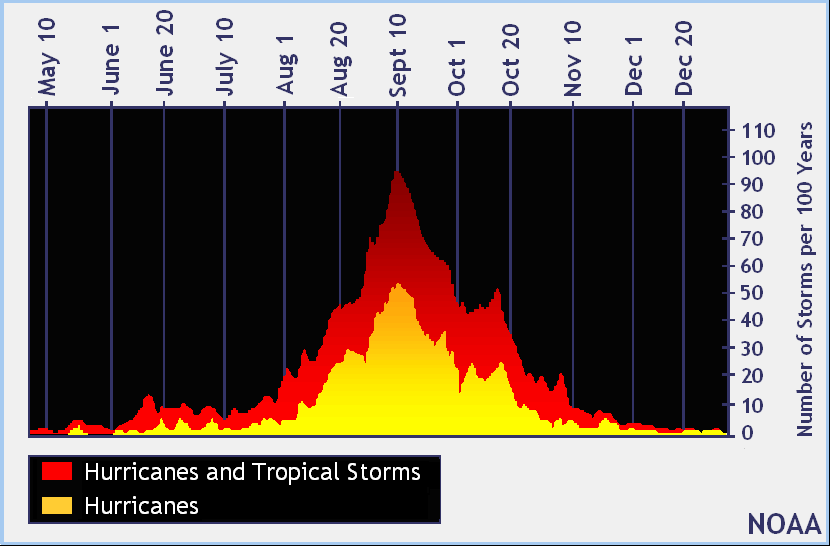
While the Atlantic Hurricane Basin is usually screaming with storms this time of year, the peak now arrives with merely a whisper with one low-probability disturbance being tracked in the Atlantic for potential tropical cyclone development. The Atlantic Hurricane Season is breaking records for just how inactive it has been. The Atlantic Hurricane Season runs June 1 through November 30 and the days right before/after September 10 are considered the usual peak of the season.
To date, the Atlantic Hurricane Basin has produced 4 named tropical storms but zero hurricanes. The first was Arthur which hit Texas in June; the second was Bertha which hit Louisiana in July. The third storm of the season thus far was Cristobal which formed in the middle of the ocean; it never threatened any land. The most recent storm was Dolly, which struck Louisiana and Texas just weeks ago in late August.
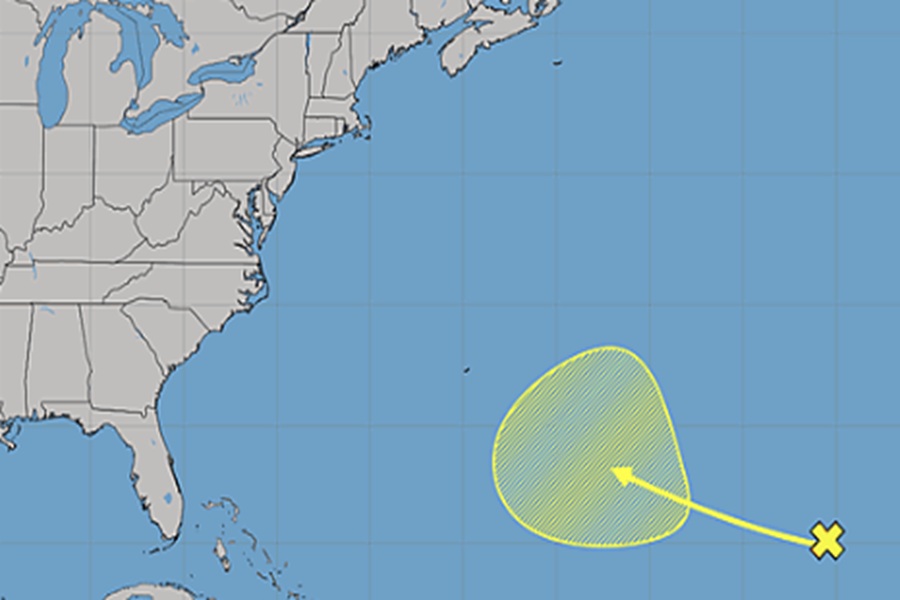
The Atlantic Hurricane Basin remains very quiet for now, with only one area being watched for signs of tropical cyclone development. A trough of low pressure located about 1,300 miles east-southeast of Bermuda is producing disorganized showers and thunderstorms. According to the National Hurricane Center, conditions are currently unfavorable for development. However, the system is expected to move into a more conducive environment for some gradual development by the middle to latter portion of this week. The disturbance is forecast to move slowly west-northwestward across the central part of the Subtropical Atlantic. For now, the National Hurricane Center says there’s a near zero percent chance of development over the next 48 hours with rises to 20% over the next 7 days.
Elsewhere in the Atlantic, tropical cyclone formation is not expected over the next 7 days.
In 1905, it wasn’t until October 8 that a hurricane formed that season, making it the latest into a season a hurricane has ever formed. The second latest season produced a hurricane on September 21 in 1941. The next latest hurricanes on record formed on September 16 in 1877, September 15 in 1922, and September 12 in 1912. Without any hurricanes on the horizon, it is likely this season will be at least the second latest-starting season on record; it is too soon to know whether the October 8 record will be in jeopardy of falling.
The 2026 Atlantic Hurricane Season has already broken the record for ACE. In meteorology, ACE stands for Accumulated Cyclone Energy, which is a metric used to measure the combined strength and duration of tropical storms and hurricanes. To calculate ACE, meteorologists take a storm’s maximum sustained wind speed every 6 hours while it is at tropical storm strength or stronger, square that wind speed, and divide the total by 10,000. The current ACE for the Atlantic is a record breaking low 4.4. The remaining top 5 years for lowest Atlantic ACE are 1984 with 7.8, 1983 with 9.5, 1962 with 10.3, and 1988 with 10.7.
The Atlantic has also broken vertical wind sheer records for the basin. The average wind sheer in the Atlantic for the past month has been 3 knots or stronger than any other year in the global satellite era which began in 1979.
