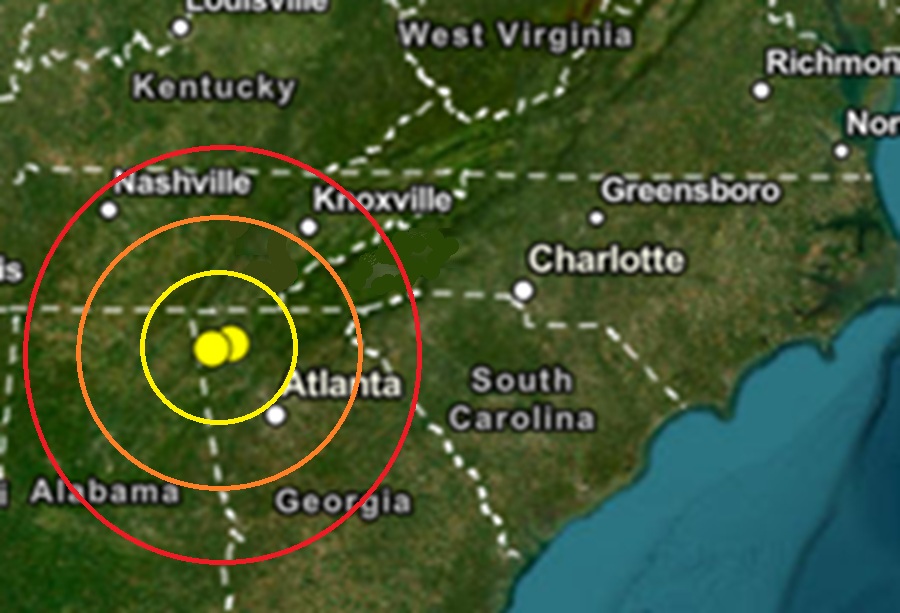
According to USGS, another earthquake has rattled northwest Georgia about 90 miles north and west of Atlanta. This latest earthquake struck at 2:34 am on Monday from a depth of 10.6 km; it was rated a magnitude 2.1 event, with the epicenter located near Trion. This earthquake struck about 10 miles away from the quake which struck the town of Resaca on Saturday. The first earthquake was stronger and was rated a magnitude 2.4 event; the depth of the quake was 9.3 km. These earthquakes struck in the most earthquake-prone part of Georgia.
According to USGS, earthquakes with a magnitude of 2.0 or less are rarely felt or heard by people, but once they exceed 2.0 more and more people can feel them. While damage is possible with magnitude 3.0 events or greater, significant damage and casualties usually don’t occur until the magnitude of a seismic event rises to a 5.5 or greater rated event.

According to Georgia’s Emergency Management and Home Security Agency (GEMA), approximately 15 percent of the world’s earthquakes are scattered over areas like Georgia that lack clearly defined active faults. Although earthquakes in Georgia are comparatively rare, scattered earthquakes caused significant damage and are an important consideration for homeowners. Georgia’s northwest counties, South Carolina border counties, and central and west central Georgia counties are most at risk.
GEMA recommends that people in Georgia plan for the risk of damaging earthquakes, especially if they’re in the northern Georgia counties of Bartow, Catoosa, Chattooga, Dade, Fannin, Floyd, Gilmer, Gordon, Murray, Pickens, Rabun, Towns, Union, Walker, and Whitfield, the South Carolina border counties of Burke, Chatham, Columbia, Effingham, Elbert, Lincoln, Richmond, and Screven, and central and west-central counties of Twiggs, Bibb, Jones, Baldwin, Hancock, Greene, Putnam, Butts, Jasper, Newton, Morgan, Walton, Harris, and Muscogee.
GEMA writes, “It’s important to be aware of your earthquake risk and to know how to protect yourself.” They encourage people to take a moment now to learn basic steps they should take before, during, and after an earthquake.
