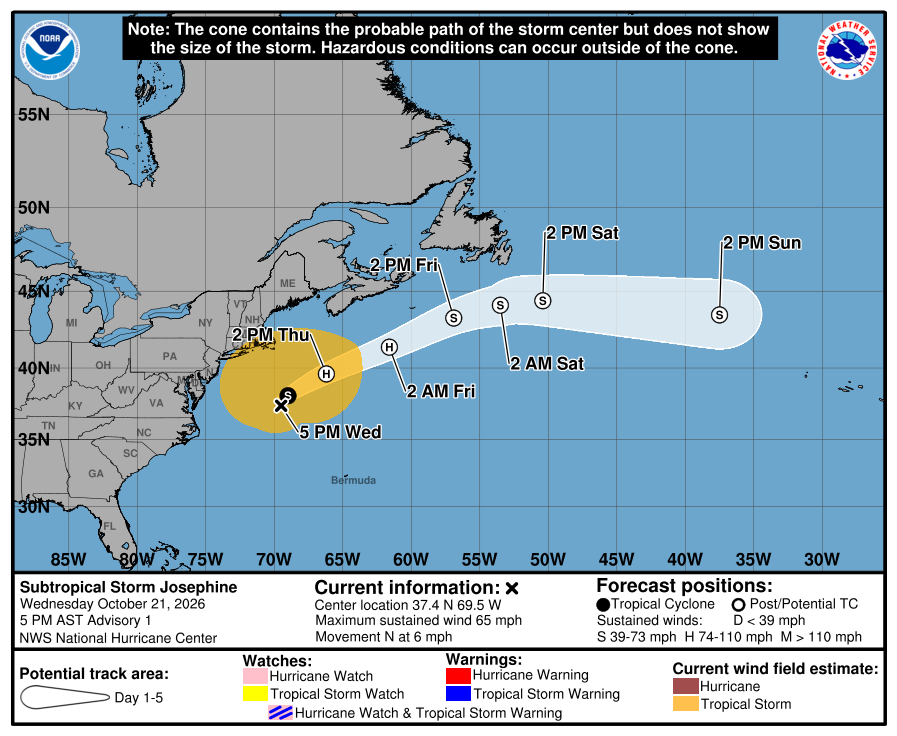
Subtropical Storm Josephine has formed well south and east of the New Jersey coastline and is forecast to move northeast away from the U.S. East Coast. However, it is expected to strengthen and get hurricane force winds in the coming days.
As of the latest advisory from the National Hurricane Center, Josephine was located about 265 miles south of Nantucket, Massachusetts and about 585 miles southwest of Halifax, Nova Scotia, Canada. Maximum sustained winds were up to 65 mph while the minimum central pressure was down to 990 mb or 29.24″.
Josephine is moving toward the north near 6 mph now but the National Hurricane Center says the storm should turn northeastward by tomorrow with a large increase in forward speed. On the forecast track, Josephine should move away from the United States and remain south of Nova Scotia and Newfoundland. As it moves north and east, some strengthening is expected, though Josephine is anticipated to remain a subtropical storm through early Thursday. Further strengthening is likely by late Thursday as Josephine becomes a post-tropical cyclone with hurricane-force winds.
Josephine is a large storm with a large wind field; winds of 40 mph extend outward up to 415 miles from the center.
The system’s precipitation shield is too far from the coast to bring rain-related flooding inland. However, hazards of wind, coastal flooding, and dangerous surf remain. Gale-force winds are possible in gusts along portions of the northeastern United States coast through Thursday. Minor to locally moderate coastal flooding is ongoing along portions of the U.S. Mid-Atlantic coast and will continue through the rest of the week around times of high tide. Large swells generated by Josephine are affecting much of the eastern seaboard of the United States and portions of Atlantic Canada. These swells are likely to cause life-threatening surf and rip current conditions.

According to the National Weather Service, a subtropical storm is a non-frontal low-pressure weather system that blends characteristics of both tropical cyclones and extratropical mid-latitude cyclones. Like a tropical storm, the National Hurricane Center issues names to them once maximum sustained winds reach 39 mph or greater. The name Josephine was selected for today’s storm because it’s on the list of 2026 Atlantic storm names the Hurricane was drawing from.
