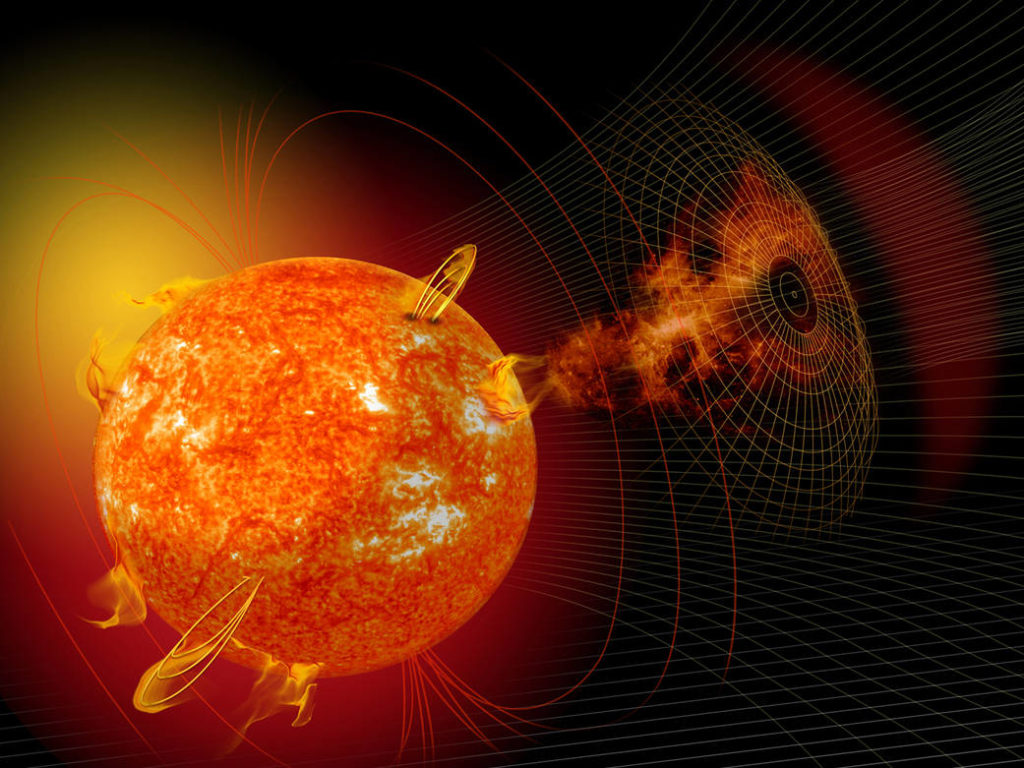
Forecasters at NOAA’s Space Weather Forecast Center (SWPC) have issued a G-3 STRONG Geomagnetic Storm Watch once again for Earth tonight, with a potentially disruptive event now possible. The SWPC says the strong geomagnetic storm could also produce atypical Northern Lights or aurora, with the glowing phenomena in the night sky possible as far south as Pennsylvania, Iowa, and Oregon. A Coronal Mass Ejection (CME) impacting Earth is responsible for this latest watch.
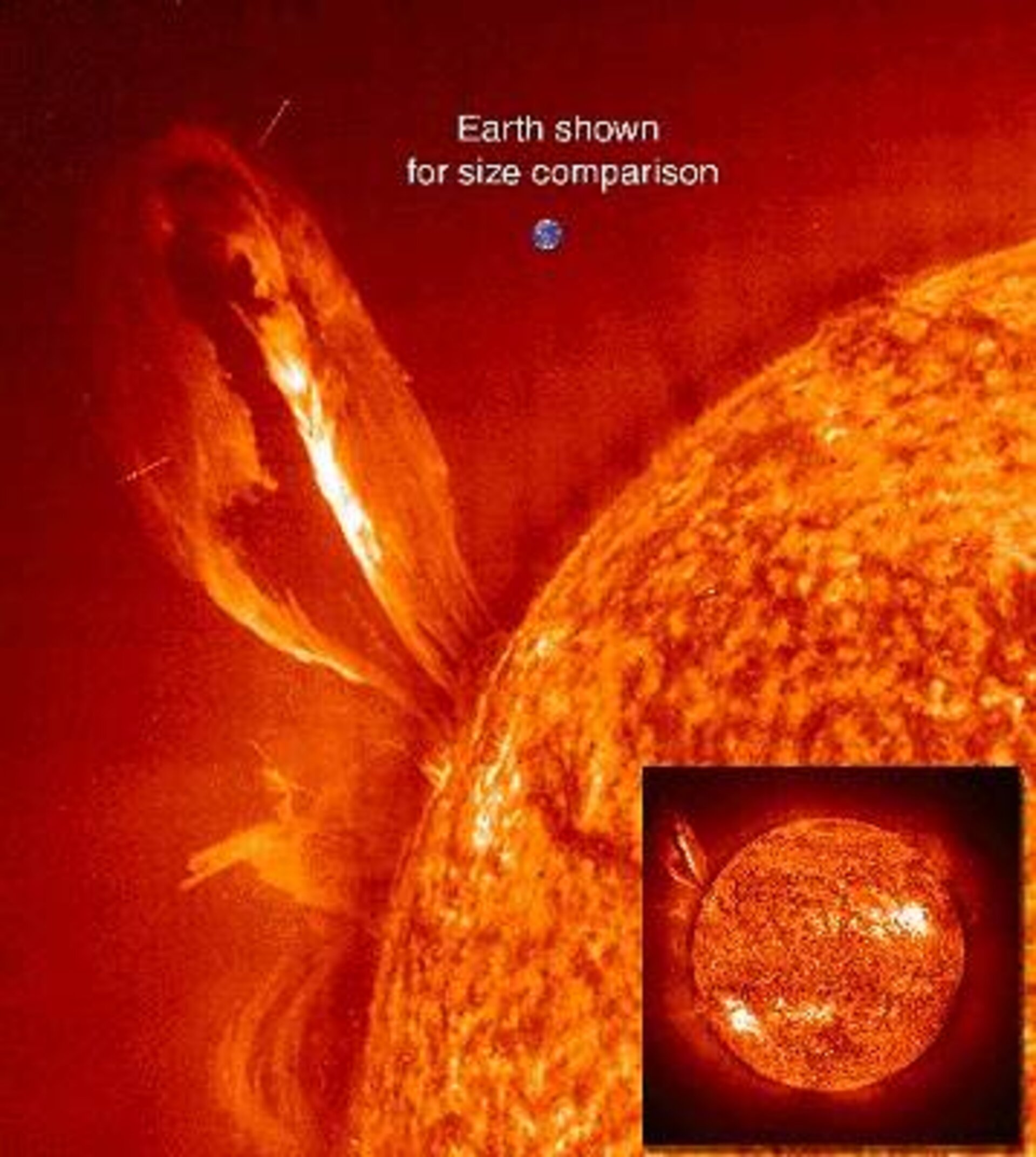
Coronal Mass Ejections (CMEs) are large expulsions of plasma and magnetic field from the Sun’s corona. They can eject billions of tons of coronal material and carry an embedded magnetic field, frozen in flux, that is stronger than the background solar wind interplanetary magnetic field (IMF) strength. CMEs travel outward from the Sun at various speeds, with some reaching the Earth as quickly as 15-18 hours and others requiring days to arrive. According to the SWPC, CMEs expand in size as they propagate away from the Sun and larger ones can reach a size comprising nearly a quarter of the space between Earth and the Sun by the time it reaches our planet.
As the CME interacts with Earth and its magnetosphere, a variety of things could unfold based on the amount of energy hitting and the angle it impacts the Earth.
“A CME is anticipated to reach and impact Earth with elevated geomagnetic response and dependent upon the orientation of the embedded magnetic field, the potential exists for Strong Storm levels,” the SWPC said. They added, “Limited, minor effects to some technological infrastructure (is) possible, but usually mitigatable. The aurora may become visible over many of the northern states and some of the lower Midwest to Oregon.”
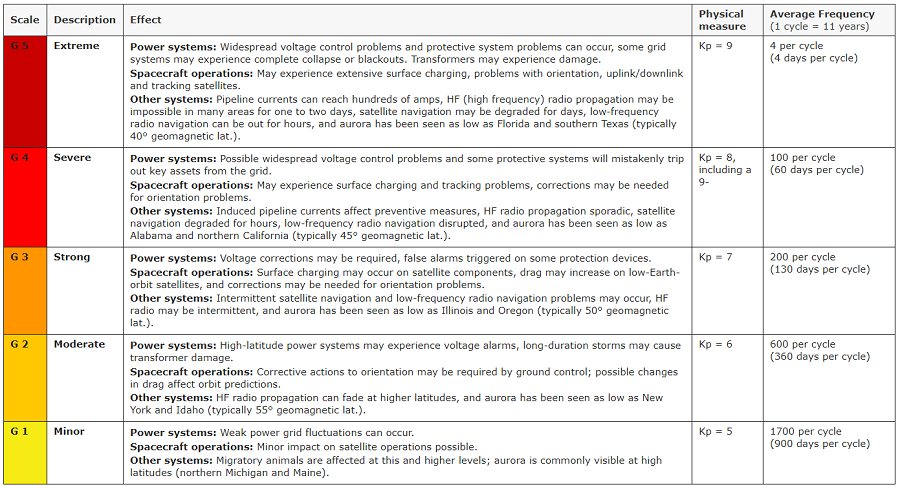
In addition to a G3 Geomagnetic Storm Watch for June 8, the SWPC has also issued a G2 Geomagnetic Storm Watch for June 9.
When the CME approaches Earth, NOAA’s DSCOVR satellite will be among the first spacecraft to detect the real-time solar wind changes and SWPC forecasters will issue any appropriate warnings. Impacts to our technology from a G3 storm are usually minimal. However, a G3 storm has the potential to drive the aurora further away from its normal polar residence, and if other factors come together, the aurora might be seen over portions of Pennsylvania, Iowa, to northern Oregon.
The probability and location of aurora displays is based on the Kp index of the storm. The K-index, and by extension the Planetary K-index, are used to characterize the magnitude of geomagnetic storms. The SWPC says that Kp is an excellent indicator of disturbances in the Earth’s magnetic field and is used by SWPC to decide whether geomagnetic alerts and warnings need to be issued for users who are affected by these disturbances. Beyond signifying how bad a geomagnetic storm’s impact can be felt, the Kp index can also help indicate how low, latitude-wise the aurora will be.
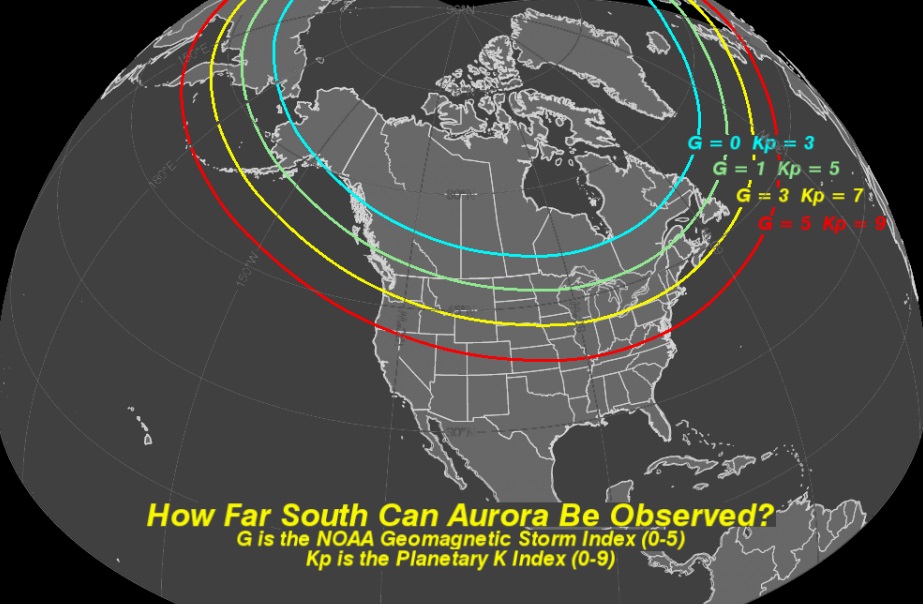
The current NOAA Space Weather Prediction Center (SWPC) forecast is calling for the G3 Strong Geomagnetic Storm event to have a Kp index of 6.67. The greater the number, the more vibrant aurora can be; in the Northern Hemisphere, a higher Kp index also means the aurora could establish itself high above the United States in southern locations that don’t ordinarily see the Northern Lights. Should the Kp index grow higher, the aurora will drive south; a Kp index of 7 or more could make the aurora present in clear skies in Boston, Chicago, and Seattle; a Kp index of 9 or more could illuminate the clear night skies of Washington, DC, Saint Louis, Denver, and even Salt Lake City. In past severe geomagnetic storms, the aurora has been visible as far south as Hawaii and the central Caribbean.
Based on the current Geomagnetic Storm forecast from the SWPC, the aurora could be visible in clouds free of light and cloud pollution across the Great Lakes, central New England, the Upper Midwest, and much of Montana and Washington. If the Kp doesn’t reach that intensity, visible aurora could be confined to Canada. If the opposite happens and the Kp surges above forecast level to 7, 8, or even 9, major cities in the Mid Atlantic, across the Midwest, and throughout the Pacific Northwest could see the aurora if sky conditions cooperated.
Beyond spectacular aurora, Geomagnetic Storms can also create other problems. Geomagnetic storms are rated on a 1-5 scale by the SWPC, with 1 considered minor and 5 considered extreme. Geomagnetic storms can disrupt electronics and electrical systems and interfere with spacecraft and satellite communication.
In the current forecast G3 / STRONG Geomagnetic Storm, there could be intermittent satellite navigation issues and low-frequency radio navigation problems. If stronger conditions develop, the electric grid and power generating plants could encounter difficulty.
NOAA forecasters analyze a variety of solar data from spacecraft to determine what impacts a geomagnetic storm could produce. Analyzing data from the DSCOVER and ACE satellite is one way forecasters can tell when the enhanced solar wind from a coronal hole is about to arrive at Earth. A few things they look for in the data to determine when the enhanced solar wind is arriving at Earth:
• Solar wind speed increases
• Temperature increases
• Particle density decreases
• Interplanetary magnetic field (IMF) strength increases
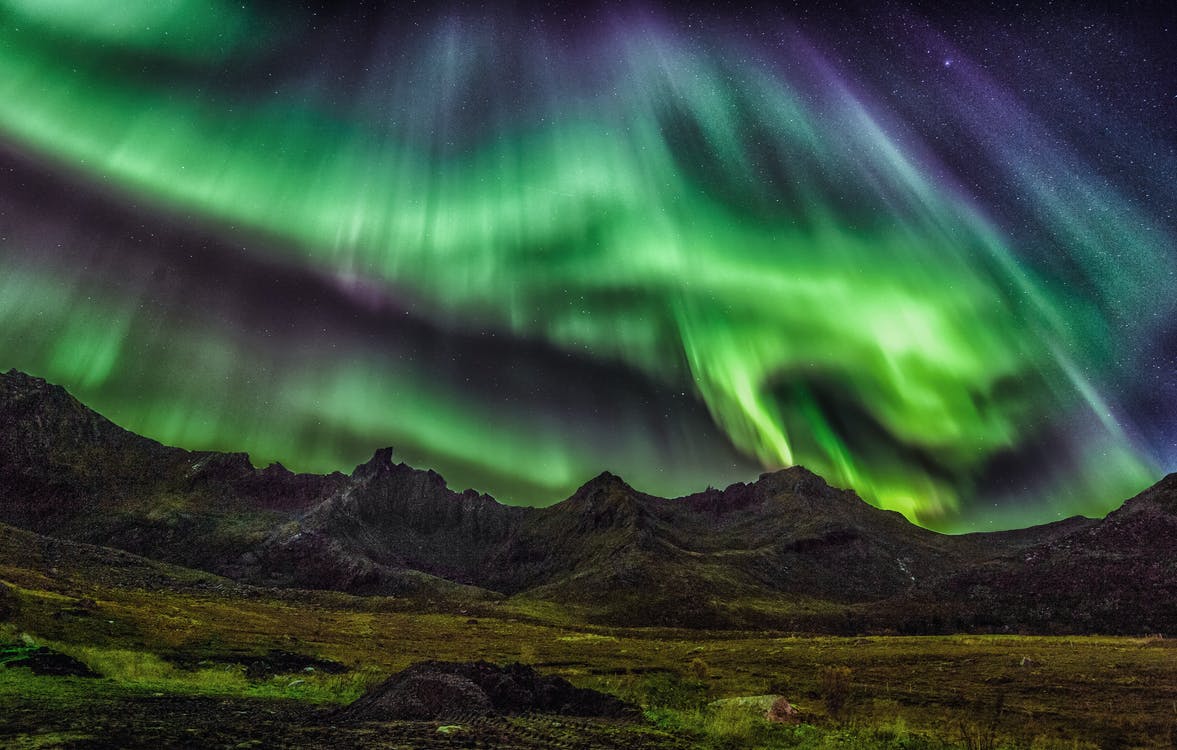
While these solar events can help illuminate the sky with stunning aurora, they can also do considerable harm to electronics, electrical grids, and satellite and radio communications.
The 1859 incident, which occurred on September 1-2 in 1859, is also known as the “Carrington Event.” This event unfolded as powerful geomagnetic storm struck Earth during Solar Cycle 10. A CME hit the Earth and induced the largest geomagnetic storm on record. The storm was so intense it created extremely bright, vivid aurora throughout the planet: people in California thought the sun rose early, people in the northeastern U.S. could read a newspaper at night from the aurora’s bright light, and people as far south as Hawaii and south-central Mexico could see the aurora in the sky.
The event severely damaged the limited electrical and communication lines that existed at that time; telegraph systems around the world failed, with some telegraph operators reporting they received electric shocks.
A June 2013 study by Lloyd’s of London and Atmospheric and Environmental Research (AER) in the U.S. showed that if the Carrington event happened in modern times, damages in the U.S. could exceed $2.6 trillion, roughly 15% of the nation’s annual GDP.
While typically known for their weather forecasts, the National Oceanic and Atmospheric Administration (NOAA) and its National Weather Service (NWS) is also responsible for “space weather.” While there are private companies and other agencies that monitor and forecast space weather, the official source for alerts and warnings of the space environment is the Space Weather Prediction Center (SWPC). The SWPC is located in Boulder, Colorado and is a service center of the NWS, which is part of NOAA. The Space Weather Prediction Center is also one of nine National Centers for Environmental Prediction (NCEP) as they monitor current space weather activity 24/7, 365 days a year.
